HOME Dog Training · 

Charles & Laura Countryman · 
1,000+ 5-star Reviews

Every other puppy course films one dog that was easy.

We filmed eight puppies over nine days. One Malinois, sure. Also a four-pound mini doodle, a great dane mix, and a border collie. Some of them nailed it the first session. Bear, who was ten weeks old and three and a half pounds, spent a whole day confused. You get to watch that part too.

Get the course · $97

21 lessons. Two and a half hours. Yours to keep.

Not ready yet? Watch the free Stop the Biting lesson first. It's Module 04 from the course.

You didn't get a difficult puppy. You got a puppy.

You brought a puppy home and now they are putting their mouth on everything. Your hands, your kids, the furniture, half of it stuff they should never have in their mouth in the first place. There is a spot on the rug. The walk is you getting pulled down the sidewalk. Nobody in the house is sleeping much.

You need some sanity. Your puppy needs some clarity.

Somebody has probably already told you your puppy is stubborn. They're not. Nobody has shown them how to live with you yet.

"We have to show your puppy how to live with you. Dogs don't know how to live with us. We teach them that."
Charles

You're not raising a puppy. You're raising an adult dog.

Here's the sentence we say to every client, usually in the first ten minutes: if it won't be cute when your dog is fifty pounds, it isn't cute at five pounds.

The jumping is cute right now. In eight months it's a paw in your stomach on the way out the door, or worse, a paw on somebody who's scared of dogs and didn't ask to meet yours. The mouthing is cute right now because the teeth are small. The pulling is manageable right now because the dog is manageable.

None of that is the puppy's fault. We've been saying it for years and it's the least popular thing we say: we create almost every problem we ever have with our dogs, and we do it by accident, by letting the small version of the behavior slide.

So the ninety days in front of you matter more than any other ninety days you'll spend with this dog. Whatever your puppy practices right now becomes the thing they do for the next twelve to fifteen years.

The problem with teaching sit first

Most puppy training goes straight at commands, because commands are the easiest thing in the world to teach and the easiest thing to film. Sit. Down. Stay. You can get a puppy sitting in an afternoon.

Then you take that puppy to the park and they've never heard of you.

Repeating the command louder won't fix it. Obedience is the top floor. It rests on whether your puppy has decent habits in your house, decent manners outside of it, and whether they'll actually look at you when something more interesting is happening. Take those away and obedience collapses the second the environment changes.

HOME stands for Habits, Obedience, Manners, Engagement. But we don't teach it in that order, and the order is the whole point.

  1. 1

    Habits / how your dog operates inside your home.

  2. 2

    Engagement / whether your dog will look at you instead of the squirrel.

  3. 3

    Manners / how your dog operates in the world, around people who didn't choose to be near a dog.

  4. 4

    Obedience / the commands, taught last, onto a foundation that can hold them.

Obedience is the easiest part. We put it at the end on purpose.

21 lessons, in the order that actually works

Module 01

Welcome to Puppy Training

Four lessons · 21 minutes

Before you teach your puppy anything, you need to decide what you're teaching them toward. This module sets that up, and it's also where we tell you what this course won't do, which saves us both some time.

You'll also find out what gear you actually need, which is less than the internet told you. We train with kibble more often than treats and explain exactly why. We'll also tell you which popular puppy product we can't stand, and what a harness is quietly doing to your leash signal every time your dog moves.

What this course is and isn't · Your house, your rules · Tools and treats: what you actually need · Setting the environment
Module 02

Habits

Three lessons · 13 minutes

Habits are how your dog behaves when you're not managing them. Get these right and you stop having to supervise your own dog in your own house.

This is where you learn the four words that become your entire language with this dog for the next fifteen years. Good, no, yes, break. Each one means something specific, and most owners collapse them into noise. It's also where potty training gets solved, and it gets solved by controlling water and food and setting an actual timer, not by hoping.

Habits versus manners, and why both beat obedience · Marker words: your dog's language · Potty training 101

Module 03

Engagement

Four lessons · 35 minutes

The longest module in the course, and the one nobody sells you.

Engagement is why your dog checks in with you. Without it, every command you own is a suggestion. You'll learn luring, which teaches your puppy that information comes out of your hands. You'll learn leash pressure, which is the single thing standing between you and a dog that walks nicely, and which almost nobody teaches properly.

And there's a lesson on play that isn't really about play. It's built on Jaak Panksepp's work on the emotional systems mammals share, and it explains why a bored dog turns into an anxious, reactive, or destructive dog four years from now. We slowed the footage down so you can watch a timid puppy named Bonnie turn confident inside four minutes.

Setting up a training session that works · Luring: teaching your puppy that hand means information · Least pressure, the most important thing on this list · Intentional play: why this isn't just playing

Module 04

Manners

Five lessons · 43 minutes

The biting. The jumping. The thing your puppy just put in their mouth on the sidewalk.

The longest lesson in the course sits here. It's about exposure, which is a different thing from socialization, and confusing the two is how well-meaning owners create the reactive dogs we spend most of our week fixing. Dragging your puppy around Home Depot so twenty strangers can pet them is not socialization. It teaches your dog that every human is theirs to greet, and one day that dog walks up to somebody who is afraid of dogs.

We want a neutral dog, not a social butterfly. We explain why, and then show you how to get one using a vacuum cleaner and about a week of doing nothing.

Exposure, not socialization · Stop the biting · Stop the jumping · Place · Drop it, not leave it

Module 05

Obedience

Five lessons · 40 minutes

Now the commands, on top of a foundation that can carry them.

Sit, down, recall, leash walking. Recall gets the most attention because we're blunt about it: if your dog never sits a day in their life, nobody dies. Recall is different. One day it's an Amazon van reversing down your driveway.

The last lesson is about dog parks, and it's the one people email about. We call them something unprintable and then tell you what to do instead.

Sit: the first real command · Down · Recall · Leash walking · Dog park training

The proof

The eight puppies

This is the part we'd want you to look at hardest.

Nearly every online puppy course is one dog. Usually a Malinois, a shepherd, a golden, a lab. Dogs bred to work with people, wildly food motivated, easy to film. Of course the training looks clean.

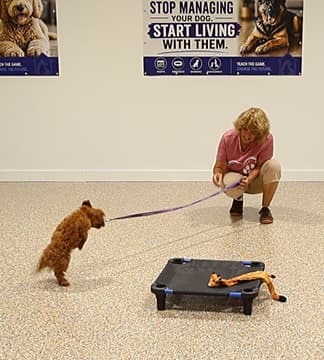
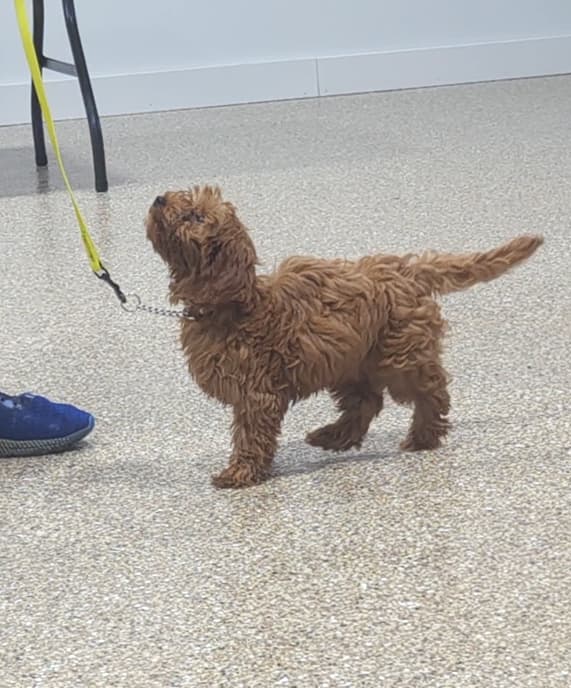
We had eight puppies in the building for nine days and we kept the camera on all of them. Penny, a mini doodle, had no concept of a leash on day one; she tangled herself in the cones and looked confused. By day seven she's floating next to us and looking up without being asked. Bear was ten weeks old and three and a half pounds and got lost in the middle of a session, so we slowed down and let him reset, and that's in the course too. Hannah backed up every single time anyone asked her to sit, so we put her on a raised cot until she ran out of room to back into.

A small doodle puppy tangled in its leash among orange training cones on the first day
Before Penny resisting the leash, day one
The same doodle puppy walking on a loose leash and looking up at its handler by day seven
After Penny on a loose leash, looking up, day seven

Some of these puppies took three sessions to get somewhere another puppy got in one. That has nothing to do with intelligence. If your puppy is the slow one in the video, that's the one to watch.

Eight minutes.
Twice a day.

8
minutes a session
2×
a day

Two sessions a day, eight minutes each, plus ten or fifteen minutes of play. That's what we did for nine days with eight puppies at once, and it's what the whole course is built around.

After about eight minutes your puppy has checked out, and anything you do past that you are doing to yourself.

Five to eight minutes, twice a day, for a month, and you'd have a dog people ask you about.

What this course won't do

It won't give you an off-leash puppy heeling through a farmers market. Your puppy is an infant. Advanced obedience has a right time and this isn't it, and any course promising you that at twelve weeks is selling you something they can't deliver.

This is for you if

You brought a puppy home in the last few months, you're somewhere between overwhelmed and mildly panicked, and you'd like your house back.

This isn't for you if

You want competition obedience, you have an adult dog with a serious behavior history, or you're looking for tricks. Different problem, different program.

The Bonus Vault

Four things we added after we finished filming

Puppy 911 Behaviors

PDF download.

Intentional Play Guide

PDF download.

The Public Outing Protocol

PDF download.

Recalls Away Bonus Technique

A bonus technique, not a download.

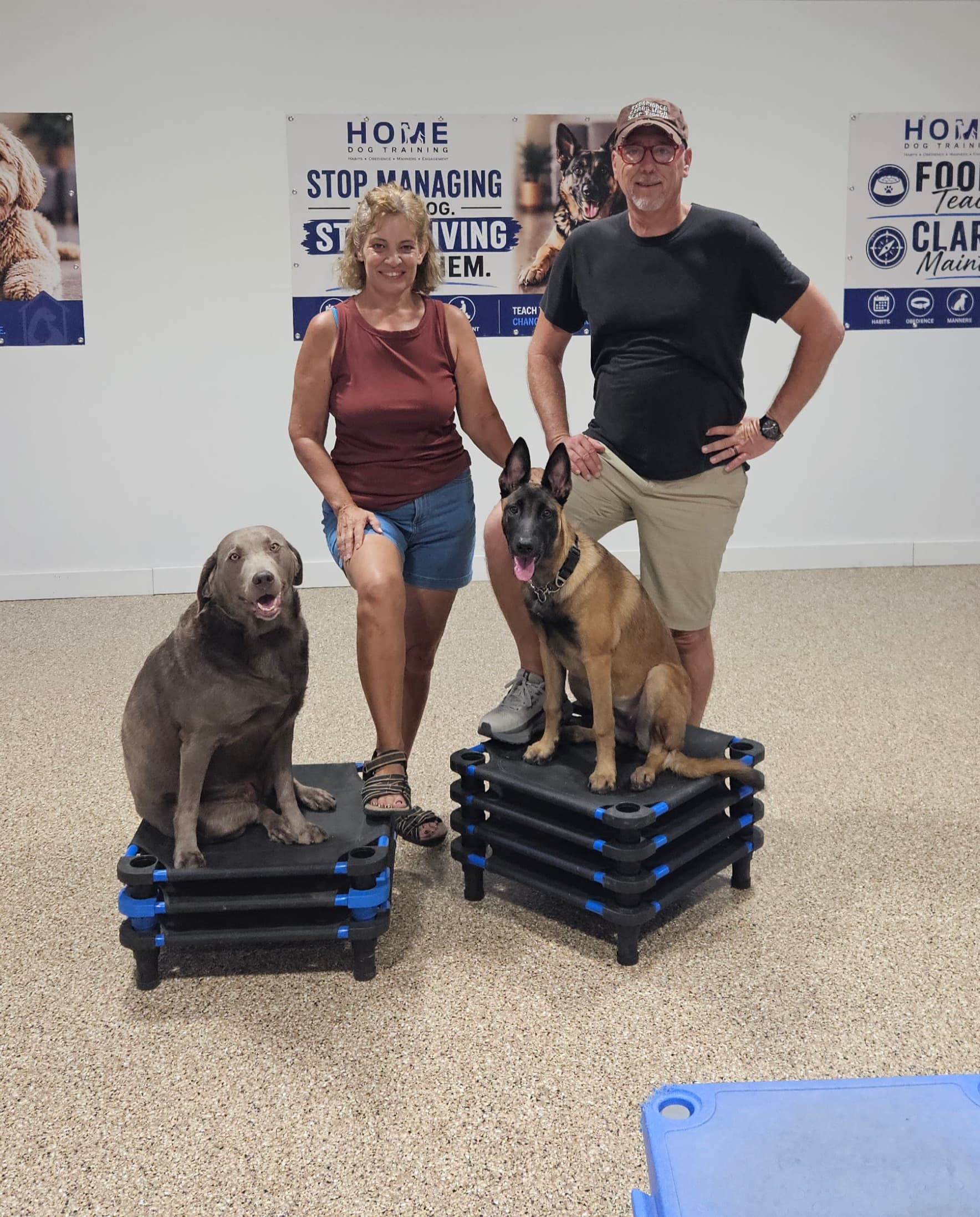
Charles and Laura Countryman, the two trainers behind HOME Dog Training, standing together with a dog

Who's teaching this

We're Charles and Laura Countryman, and we run HOME Dog Training out of Rockwall, Texas. Over the years, we've trained more than five hundred dogs, and earned over a thousand five-star reviews.

Most of the dogs that come through the door are adults with problems that started when they were puppies. Pulling. Jumping. Fear of a vacuum cleaner. Reactivity that traces back to one bad afternoon at a dog park when the dog was five months old. We've spent years untangling things that would have cost the owner eight minutes a day to prevent.

That's the course. It's the conversation we wish we could have had with those owners two years earlier.

500+
dogs trained
1,000+
five-star reviews
"It is totally unfair to expect your dog to outwork you."
Charles

$37 add-on at checkout

Add the Full Leash Course and learn how to enjoy walking your dog.

Nine out of ten adult dogs that come to us are here because nobody taught them the leash. We have trained dogs whose owners showed up with a broken collarbone, a broken arm, a broken hip. Twice.

The puppy course gets your dog walking loose next to you. This one teaches heel.

  • 1 Leash Walking Basics. Where the collar sits, how to hold the leash so your shoulder isn't doing the work, and the release command most people skip.
  • 2 The Value of Circle Drills. A five-block walk gives your dog about six good repetitions and a few hundred bad ones. Circle drills fix that ratio.
  • 3 Heel Drills. Using a wall so your dog stops kicking their hip out, then working your way off the wall.
  • 4 Finding Your Dog's Motivator. Your dog answers this question, not you. Some work for food, some won't.
  • 5 Engagement and Motivation. Why your dog remembers a session that was fun and forgets one that was boring.

$37, added at checkout.

The offer

HOME Puppy Foundation

  • 21 video lessons across 5 modules
  • Two and a half hours, taught in the HOME order
  • Eight real puppies, mixed breeds, filmed over nine days
  • The Bonus Vault, including Puppy 911 Behaviors and the Intentional Play Guide
  • Downloads and homework for every module

$97

Under five dollars a lesson.

Start the course

FAQ

How do I get access after I buy?

You'll get an email with a link. You create an account in the learning platform, and the whole course lives there.

How long do I have access?

For life. It doesn't expire.

Do you offer refunds?

We don't offer refunds at this time.

Can I watch on my phone?

Yes. Phone, tablet, laptop, whatever you have in your hand when the puppy is finally asleep.

How long does the whole course take?

About two and a half hours of video. Don't sit down and watch it all at once. Watch a module, go train for eight minutes, come back.

Do I have to watch it in order?

Mostly, yes. The order is the method, and skipping to the obedience module is the exact mistake the course is built to prevent. Puppy 911 is the exception. If tonight is rough, start there.

Can my spouse and kids use it too?

They should. Everyone who handles the puppy needs to watch the marker words lesson at minimum, or your dog ends up hearing four different languages from four different people.

Do I need a second person to do the training?

No. We show two-person recall because it builds drive, and then show you how to run the same thing by yourself.

What do I have to buy?

Less than you think. A flat collar, a six-foot leash, whatever kibble you already feed, and a few toys. For place work, we use a rubber mat you can buy in a four-pack for about forty dollars. We do not use harnesses while training and explain exactly what a harness does to your signal, and we'll tell you which popular chew toy we refuse to use.

My puppy isn't that into treats.

Most puppies are, and this comes up far more with adult dogs. If yours isn't, Module 3 covers finding what does motivate them. Usually it's a toy, and usually the problem is that somebody handed the toy over instead of making it worth chasing.

My puppy is already six months old. Too late?

No. You have some habits to replace instead of habits to build, which is a little more work and completely doable. Everything in the course still applies.

Is this harsh?

No. The course runs on luring, marker words, and leash pressure. We're specific about this: "no" is information, not punishment, and it doesn't have to come with a correction. We'll also show you a moment where we time a treat wrong, ruin a rep, and say out loud that it was our mistake and not the dog's.

My dog is five pounds, or a mixed breed, or not a shepherd.

Good, so were most of ours. Penny is a five-pound mini doodle and she's in a lot of the footage. Little dogs like to learn as much as big ones.

Is the leash course included?

No, it's a separate $37 add-on you can check at checkout.

The next twelve years start this week

You're going to spend a decade and a half with this dog. Which parts of that are pleasant gets decided mostly in the next couple of months, by things that feel small right now.

Eight minutes, twice a day. Ninety days of paying attention. That's the whole ask.

Get the HOME Puppy Foundation · $97

Instant access after checkout.

Not buying today?

Watch the free Stop the Biting lesson first. It's a lesson from Module 04 of the course, free once you give your first name and email.

Watch the free Stop the Biting lesson

$97

21 lessons. Yours to keep.

Get the course · $97